The Analytics With Avery Blog
Breakouts, Bounce Backs, and Bottom-of-the-Graphs
By Avery Doiron | January 9, 2026
Introduction
Note: This post was written using an earlier version of my player card model and design. The player cards shown below are from that older version and the project has since been updated with a new model and visuals.
With the 2025-26 season at its halfway point, I wanted to take a closer look at several players having particularly interesting seasons. I focused on three categories: breakout seasons, where a player is performing significantly better than in previous years; bounce-back seasons, where a player is playing at a high level again after one or more down seasons; and, to keep the alliteration going, bottom-of-the-graph seasons, where a player is having possibly the worst season of their career, as illustrated by their metrics appearing at the bottom of the visualized graphs.
For each category, I selected one forward, one defenseman, and one goaltender. Some of these players have already received plenty of attention, while others have flown more under the radar than I think they should. These selections aren’t necessarily the most extreme examples of each category, but rather players I specifically wanted to take a deeper look at. All player sections are accompanied by my custom NHL player cards for each player, which have been updated to include all games up until January 8th.
Breakouts
Luke Evangelista
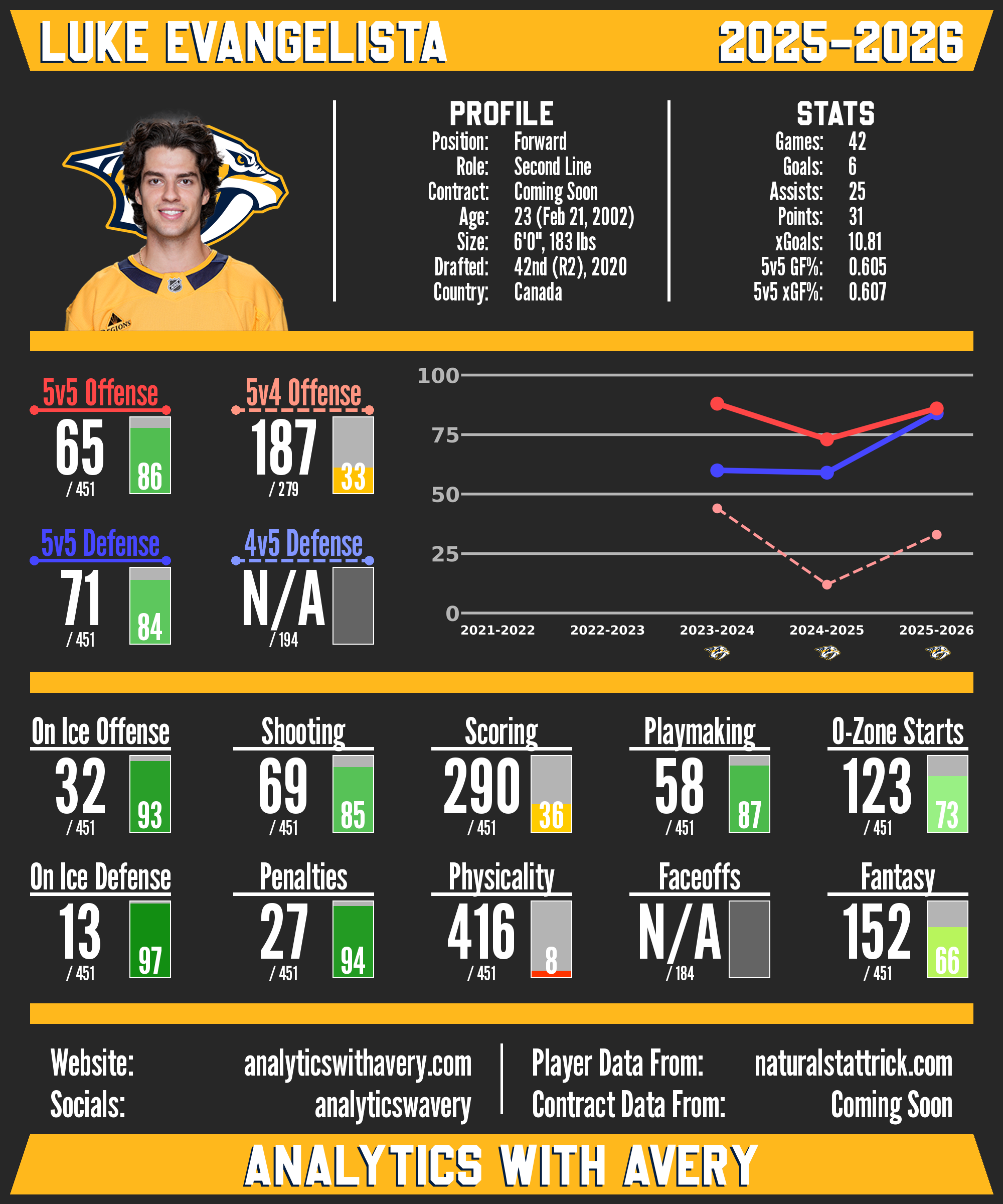
Ever since entering the league, Luke Evangelista has consistently had great underlying numbers, and this season, the production is finally there to back up just how effective he can be. He has jumped from an average of 0.50 points per game in his first 172 games over the past three seasons to 0.74 points per game with his 31 points in 42 games this season. He ranks 6th among all forwards with at least 200 minutes played at 5v5, posting a 0.607 5v5 xGF%, with his actual 5v5 GF% sitting at a similarly impressive 0.605.
Evangelista is also shooting just 6.5%, suggesting his goal total could climb if he sees more puck luck. At only 23 years old, Evangelista is already one of the most underrated players in the league and he's just going to keep getting better.
Darren Raddysh
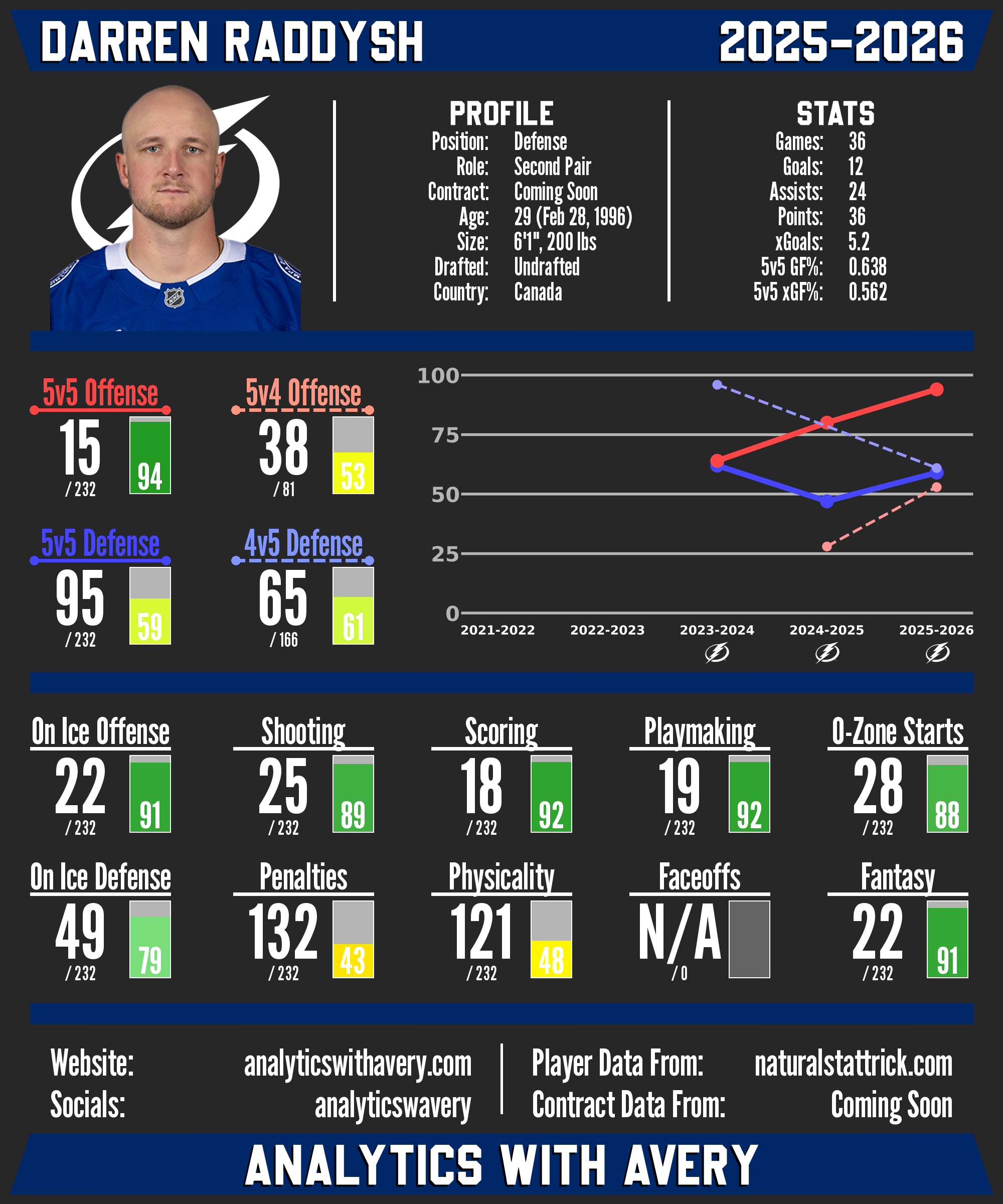
What a season Darren Raddysh is having. He’s producing at a point-per-game pace with 36 points, just one shy of his career high, while doing so in 37 fewer games. His 5v5 GF% is an impressive 0.638, while his 5v5 xGF% is 0.562. With Victor Hedman's absence for a lot of this season, Raddysh has really stepped up and helped Tampa stay in a playoff spot in the Atlantic Division. Is this just a flash in the pan for Raddysh, or is this truly the player he is?
While his production wasn't as high in previous seasons, his underlying numbers were still solid. Out of the 12 goals he has, 6 have come during even strength, where his shooting percentage isn't that outlandish, being 8.93% at 5v5, ranked 39th out of all defensemen who've played 200 minutes. The other 6 goals have been on the power play, where he is shooting a very high 26.32%, ranking 3rd out of defensemen who have played 50 minutes on the power play. Knowing this, his power play numbers may come down a bit, but his even-strength performance seems sustainable which is enough to credit him as a reliable offensive defenseman right now.
Dan Vladar
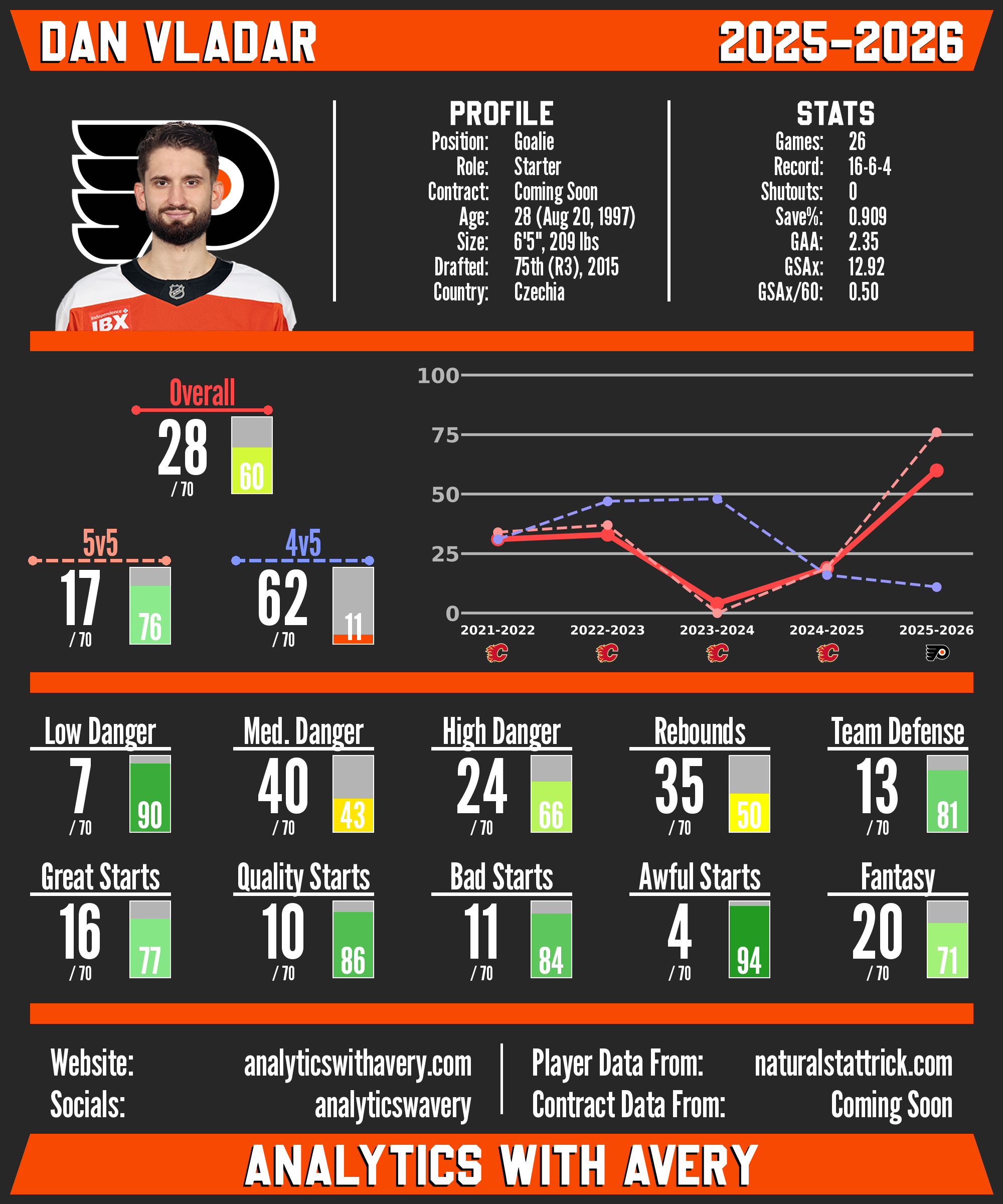
This season, Dan Vladar has emerged as Philadelphia’s clear starting goaltender, playing a key role in the Flyers sitting in a playoff spot in the Metropolitan Division. In 26 appearances, Vladar has posted a save percentage above 0.910 in 18 games, and on the season he has a GSAx of 12.92.
After spending much of his career in a backup role, Vladar signed a two-year, $3.35 million contract with Philadelphia, a team that entered the season without an established starter. His consistent play has provided the Flyers with dependable goaltending on a night-to-night basis – something that was far from certain heading into the year.
Bounce Backs
Troy Terry
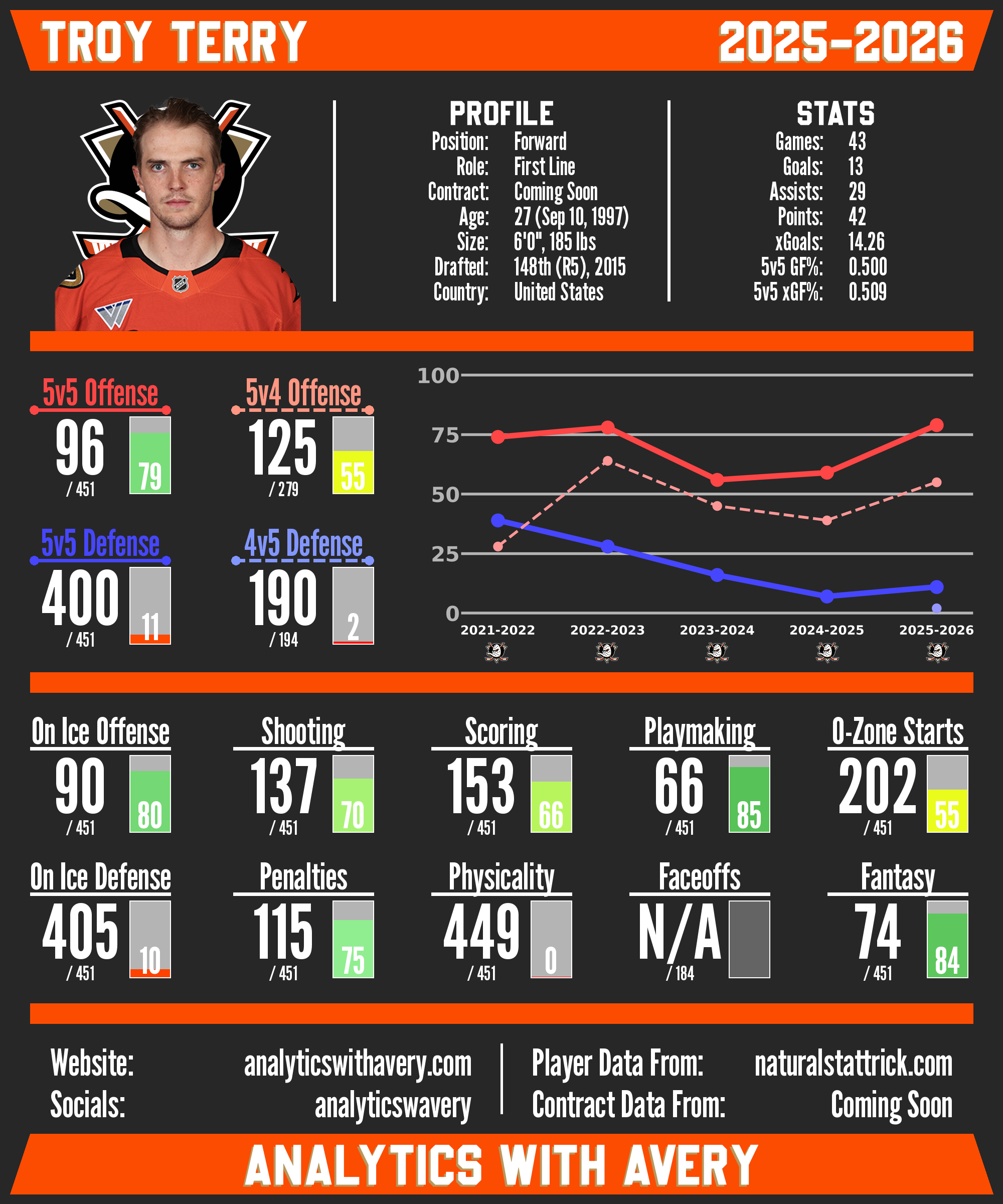
After breaking out in the 2021-2022 season with 67 points in 75 games, Terry had 61 points in 70 games, 54 in 76 and 55 in 77, in the following three seasons. This season, Terry is already up to 42 points in 43 games and was a big player for the Anaheim Ducks' hot start. The Ducks have since cooled off a bit, but Terry has not, registering 8 points in his last 10 games and having a 5v5 xGF% of 0.585 in that span.
Terry has been driving play and giving Anaheim a reliable offensive engine even as the team has gone through ups and downs in the standings. If the Ducks want to continue their push for the playoffs, they'll need Terry to keep stepping up while some of the younger players find more consistency in their game.
K'Andre Miller
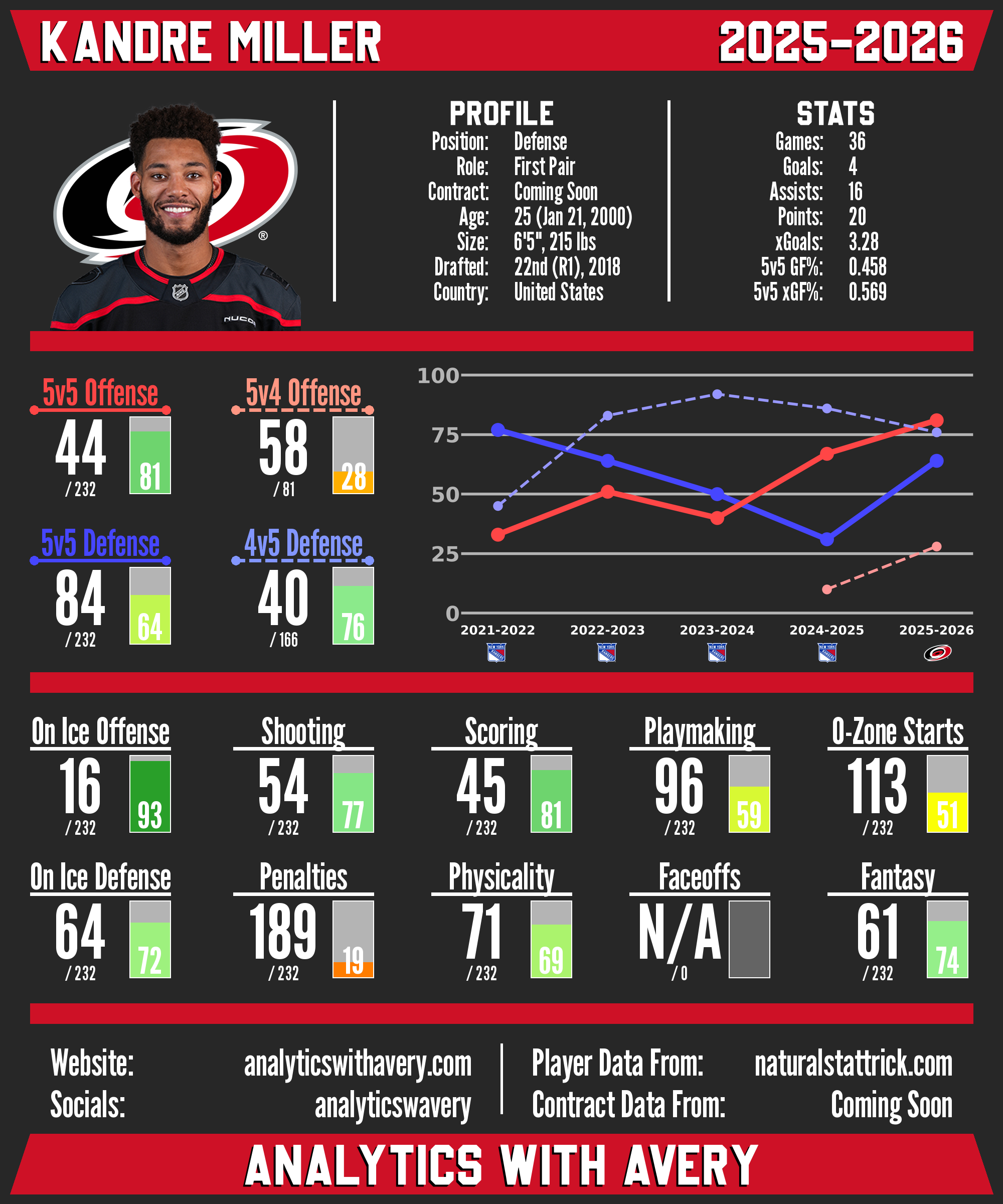
Last season, K'Andre Miller became a polarizing player to New York Rangers fans. After being traded, opinions were split. Some fans welcomed the move, while others felt there was more to his game than what he showed last season. This season, his offensive game has improved since last season, but where the big bounce back is happening is in his defensive play. When he first came into the league, he was stellar at defending, but his performance has steadily declined over the past few seasons. Now that he's with the Hurricanes and Rod Brind'Amour's defense-heavy system, he's back to his top-tier defensive play.
With Jaccob Slavin out for most of this season with an injury, Miller has been paired with Sean Walker on the Canes' top pair. When these two have been on the ice, the team has been outshooting their opponents 218 to 167. Miller's actual 5v5 GF% hasn't been amazing, being only 0.458, but his xGF% has been a much nicer 0.569, so hopefully he can experience some positive regression to get his actual closer to his expected.
Philipp Grubauer
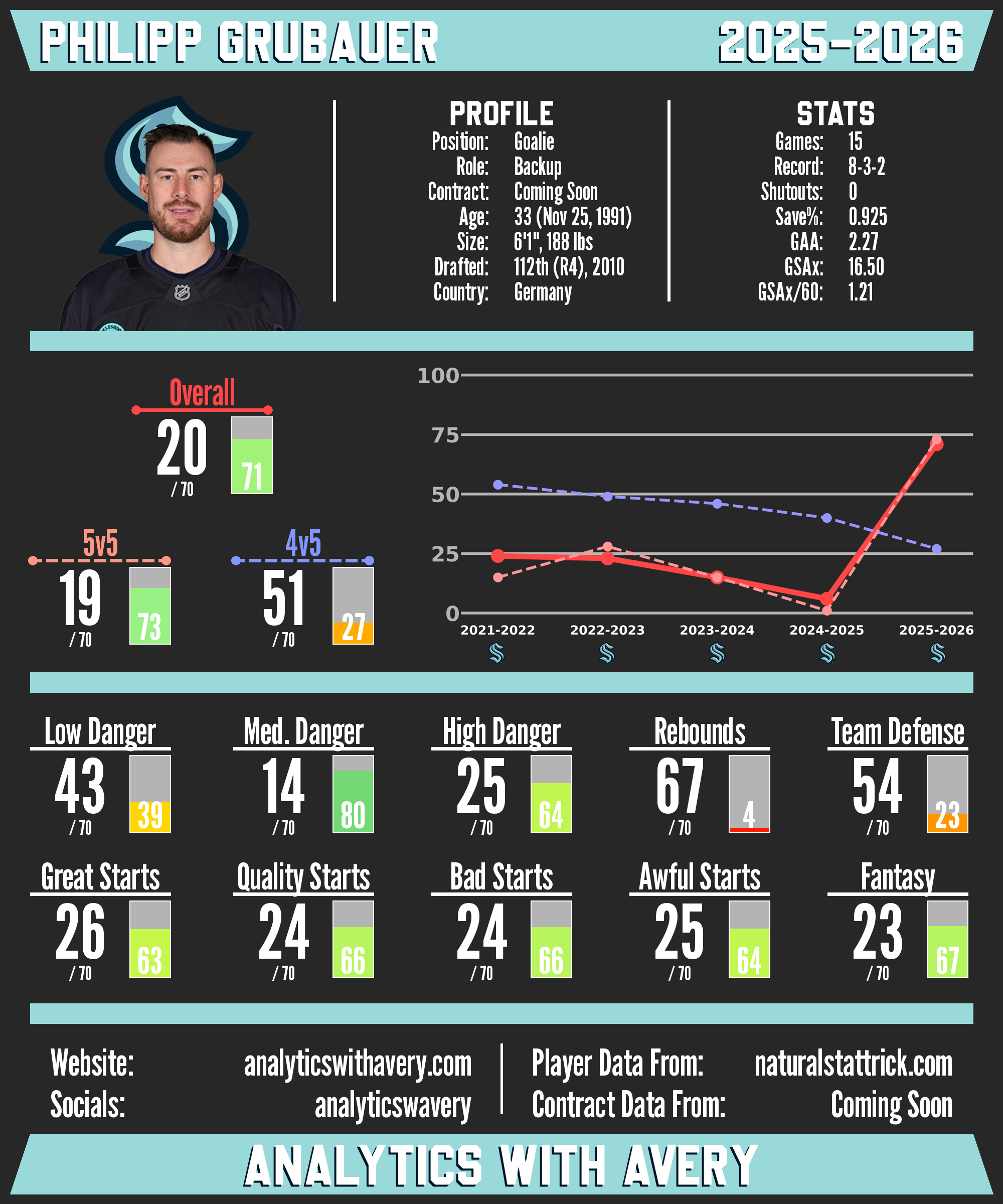
It's not an understatement to say that Grubauer has been excellent this season. After joining the Seattle Kraken in 2021, Grubauer went from a 0.922 save percentage and a Vezina nomination with Colorado to having four consecutive seasons with a save percentage below 0.900. His worst stats came last season, where he had a 0.875 save percentage and -16.73 goals saved above expected. So far this season, his save percentage has been an impressive 0.925, and his goals saved above expected have been a positive 16.50.
It's not the biggest sample size with Grubauer having played just 13 games so far, but he's been playing more frequently as of late and with these numbers, he's deserved it. Has it been the work of the newly hired Kraken goalie coach, Colin Zulianello? Or maybe it's the motivation and preparation for the upcoming Olympics, where Grubauer will serve as Team Germany's starter? Whatever it is, if he keeps it up, the Kraken might have a shot at returning to the playoffs this season.
Bottom-of-the-Graphs
Trent Frederic
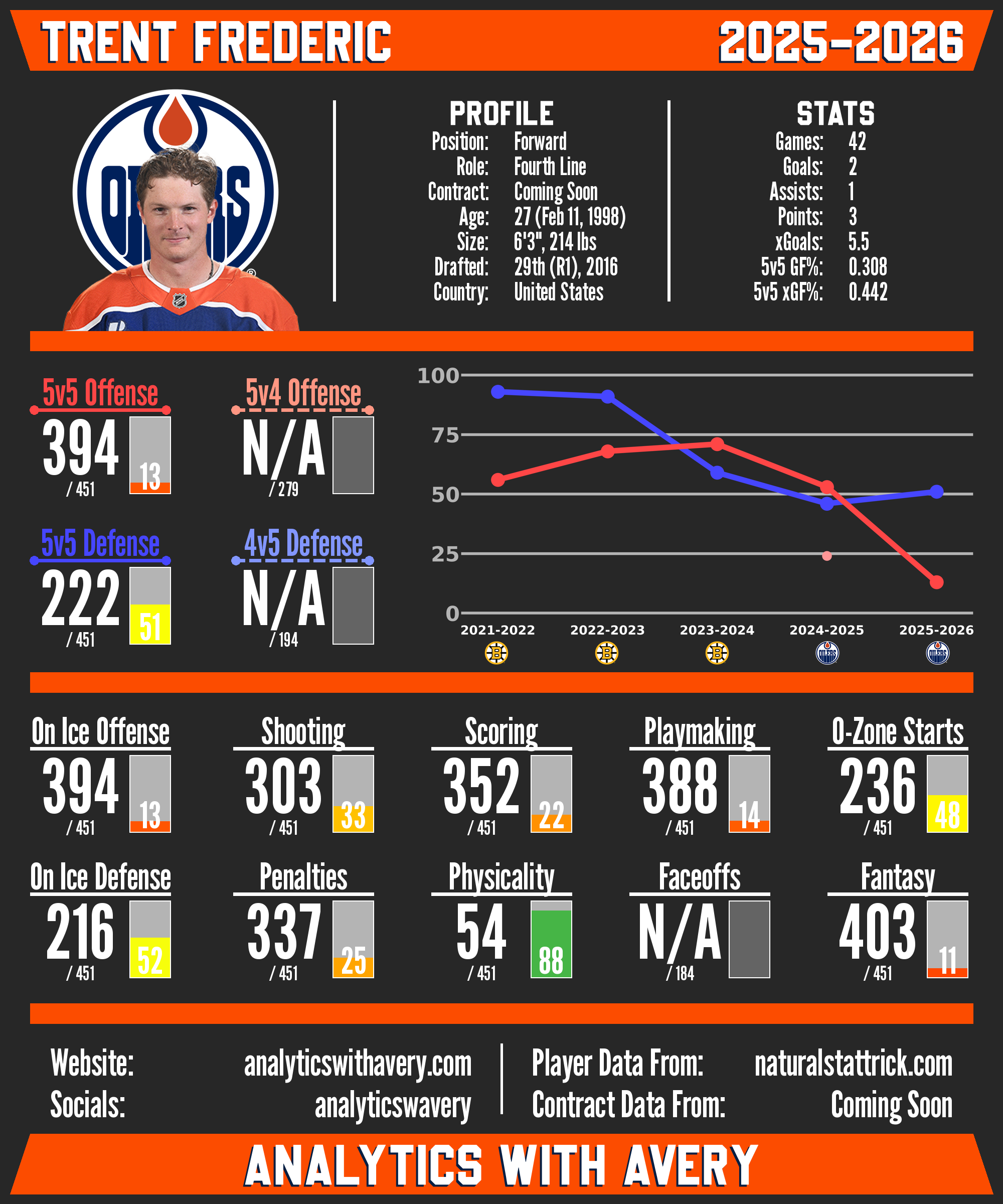
I think most of us were scratching our heads when the Oilers signed Frederic to an eight-year, $3.85 AAV contract extension. This seemed like a bit too much money for way too long. Frederic's play this season hasn't exactly been proving most of us wrong. In 42 games, his offensive play has been shocking, recording only 1 goal and 2 assists. His defensive play hasn't been much better either. At 5v5 he's had a rough 0.442 xGF% and an even worse 0.308 actual GF%.
The main thing he has going for him in his play right now is his physicality, but is that enough to warrant the price that Edmonton will be paying him over the next seven seasons?
Brandon Carlo
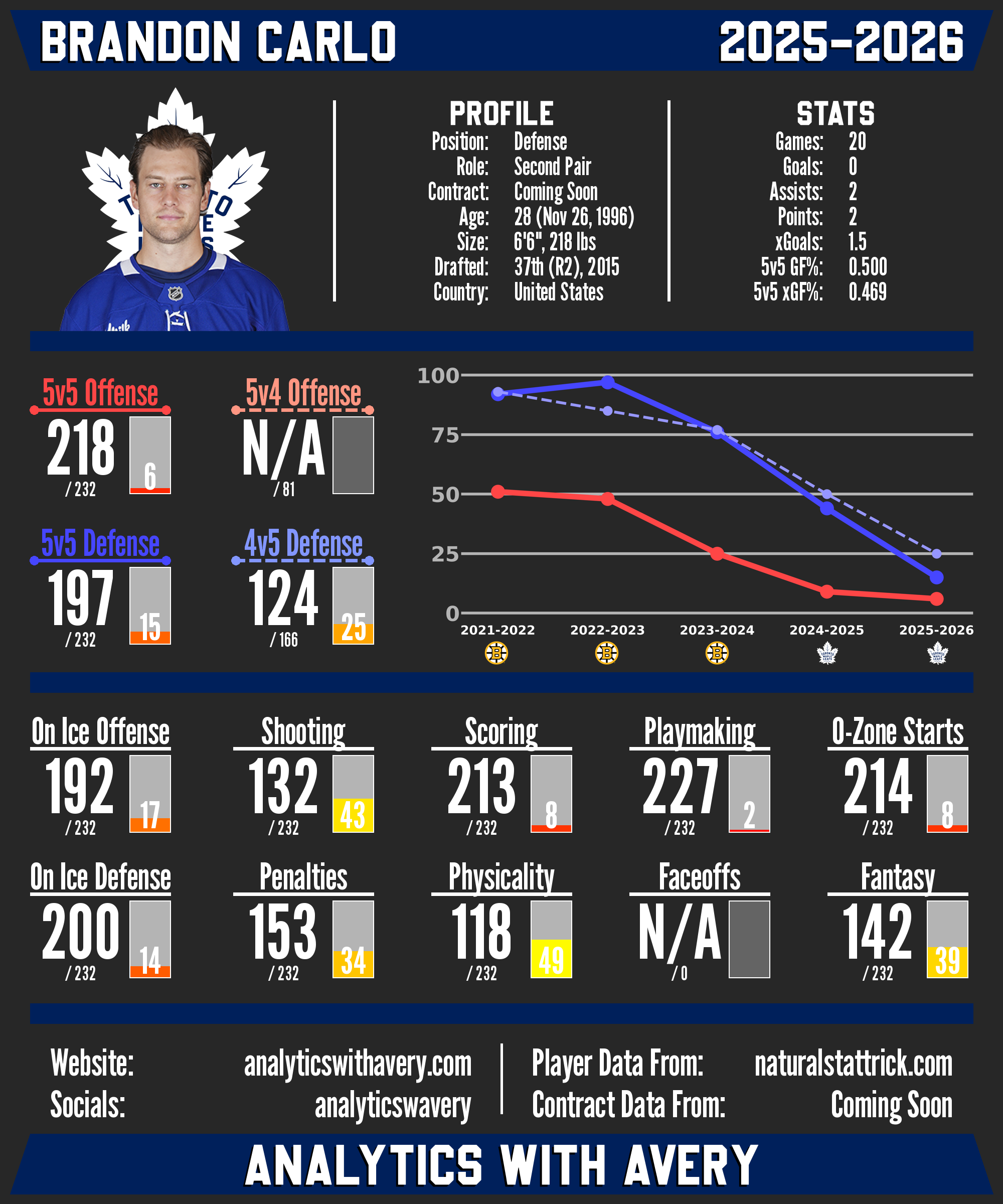
Brandon Carlo's play has been steadily declining for some time now, but this season it's hit an all-time low. He's not producing, having only 2 assists in 20 games, and he's been struggling to defend. He has missed games due to injury, which surely hasn't helped his play. Giveaways and takeaways aren't the most reliable public stats, but notably, Carlo has 19 giveaways and just 2 takeaways.
Carlo just hasn't really been adding too much to a Leafs team that has struggled at times during this season. He still has two years left on his contract, which has a $4.1M cap hit, and when you consider what the Leafs gave up to trade for him (Fraser Minten, a 1st and a 4th round pick), you'd really expect more from him.
Jordan Binnington
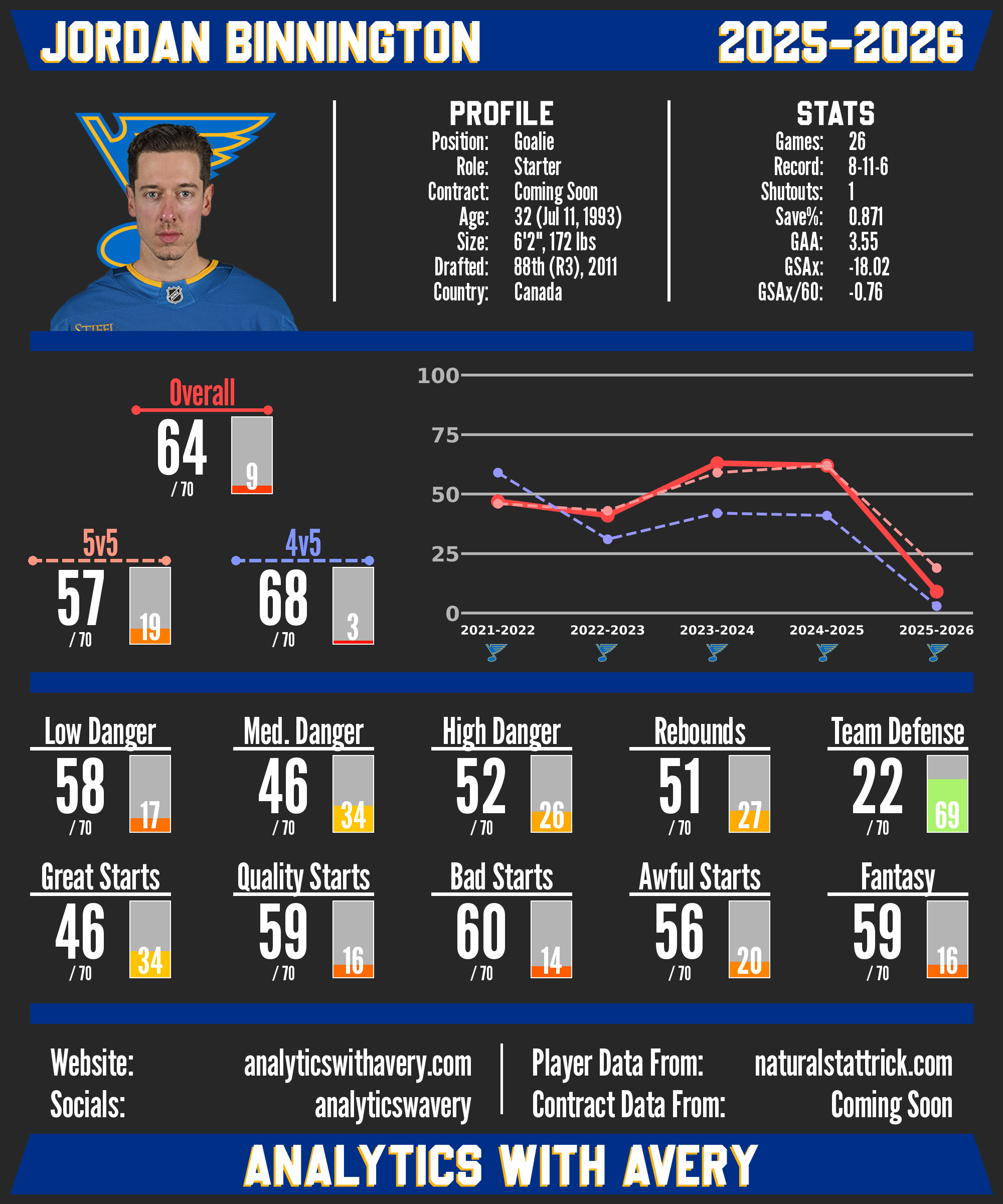
Jordan Binnington has posted some of the worst numbers of any starting goaltender this season. The St. Louis Blues currently rank tied for 3rd worst team save percentage and sit at 4th-worst in the league standings (they also rank last in goals for per game, so their struggles aren't just due to goaltending). In 26 games, Binnington has recorded a 0.871 save percentage, a 3.55 goals against average, and a goals saved above expected of -18.02, all among the worst in the league.
Despite all this, Binnington was still selected for Team Canada. I can admit that I projected him to make the roster, but it certainly wasn’t based on his play this season. If Canada sees anything resembling his typical regular-season form instead of the version from the Four Nations final, he’d be better suited in the press box during the tournament.
Conclusion
Few things illustrate the NHL’s volatility better than the range of player performance seen at the same point in a season. Breakout players show how opportunity and progression can turn strong process into real impact. Bounce-back seasons from players highlight that declines aren’t always permanent, and that adjustments, whether technical, situational, or mental, can lead to dramatic turnarounds. On the other end of the spectrum, these bottom-of-the-graph seasons serve as a reminder that age, usage, and team context can quickly catch up to players who once filled important roles.
As the season moves into its second half, these trajectories will continue to evolve. Some breakouts may regress, some bounce-backs may solidify, and some bottom-of-the-graph seasons may stabilize or worsen. Tracking these patterns over time not only helps contextualize individual performance, but also provides insight into how teams evaluate talent, manage risk, and adapt as the season unfolds.